Introduction
If you have ever sat down to plan your marketing calendar and asked yourself, “Should I be spending more time on Instagram or Pinterest?” — you are not alone. It’s one of the most common questions bloggers, ecommerce brands, coaches, and digital product sellers ask when they’re trying to figure out where to put their limited time and energy.
Both platforms are visual. Both can drive traffic, leads, and sales. But they work in completely different ways, and treating them the same is one of the biggest mistakes business owners make.
Quick answer: Pinterest works better for long-term, evergreen traffic and search-based discovery, while Instagram works better for real-time engagement, community building, and brand personality. Most businesses benefit from using both — but for different goals, not the same content strategy.
Let’s break down exactly how these two platforms compare, so you can decide where to focus first.
Table of Contents
Why People Compare Instagram and Pinterest
Instagram and Pinterest get compared constantly because they look similar on the surface. Both are visual-first platforms. Both support photos, videos, and short-form content. Both are popular with the same types of creators — bloggers, product sellers, coaches, and small brands.
But that’s really where the similarities end. Instagram is a social media platform built around people and conversations. Pinterest is a visual search engine built around ideas and intent. Once you understand that core difference, most of the confusion about “which one is better” starts to clear up.
What Makes Instagram Different
Instagram is built for connection. People open the app to see what their friends, favorite creators, and favorite brands are doing right now. The content is conversational, personality-driven, and tied closely to trends, audio, and culture.
A few things define Instagram marketing:
- Content is time-sensitive — a post’s visibility drops sharply after 24–48 hours
- Success depends heavily on consistency, engagement, and community interaction
- Reels and Stories reward personality and real-time relevance
- Algorithm favors accounts that keep users on the platform longer
- Followers matter — your reach is tied closely to your existing audience size
Instagram is a place to build relationships. It’s less effective at driving people off the app and onto your website, since the platform is designed to keep users scrolling within it.
What Makes Pinterest Different
Pinterest is often miscategorized as “just another social platform,” but it behaves much more like Google or a visual search engine. Users come to Pinterest actively looking for ideas — recipes, home decor inspiration, business tips, outfit ideas, templates, and more.
A few things define Pinterest marketing:
- Content (Pins) can drive traffic for months or years after publishing
- Discovery is based on search and interest, not follower count
- New accounts with zero followers can still get significant reach
- Pinterest SEO — keywords in titles, descriptions, and boards — directly impacts visibility
- Users are often in a planning or buying mindset, which makes it strong for traffic and conversions
This is why Pinterest is frequently described as having “evergreen” content. A well-optimized Pin published today can still be sending traffic to your website a year from now — something that’s rare on Instagram.
Instagram vs Pinterest: Side-by-Side Comparison
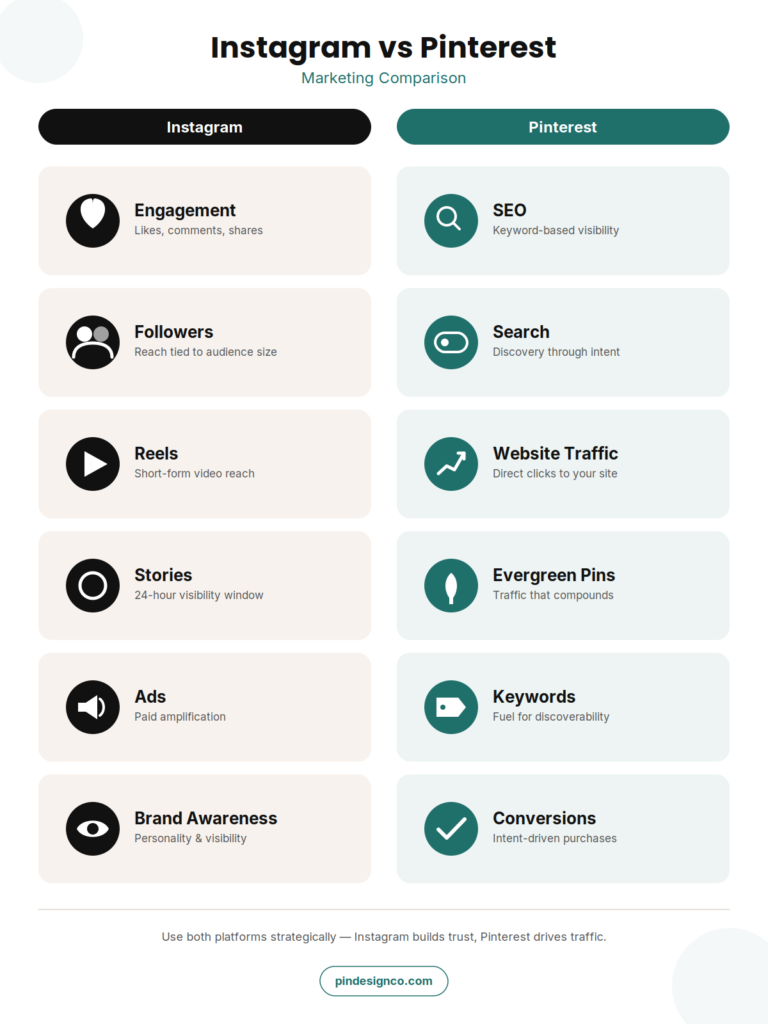
Audience & User Intent
Instagram users are typically in a browsing or entertainment mindset — they want to be inspired, entertained, or connected to people they follow. Pinterest users are typically in a planning or research mindset — they’re actively searching for solutions, products, or ideas, often with intent to act (save, click, buy).
Content Lifespan
| Platform | Average Content Lifespan | Why |
|---|---|---|
| 24–48 hours (Feed/Reels), up to 24 hrs (Stories) | Feed is chronological/algorithmic and recency-driven | |
| Several months to multiple years | Pinterest functions as a search engine, indexing and resurfacing Pins over time |
Organic Reach
| Platform | New Account Reach | Long-Term Reach Potential |
|---|---|---|
| Low without existing followers or paid promotion | Reach plateaus without consistent, high-engagement posting | |
| High, even with zero followers | Reach compounds over time as Pins get re-indexed for relevant searches |
SEO & Discoverability
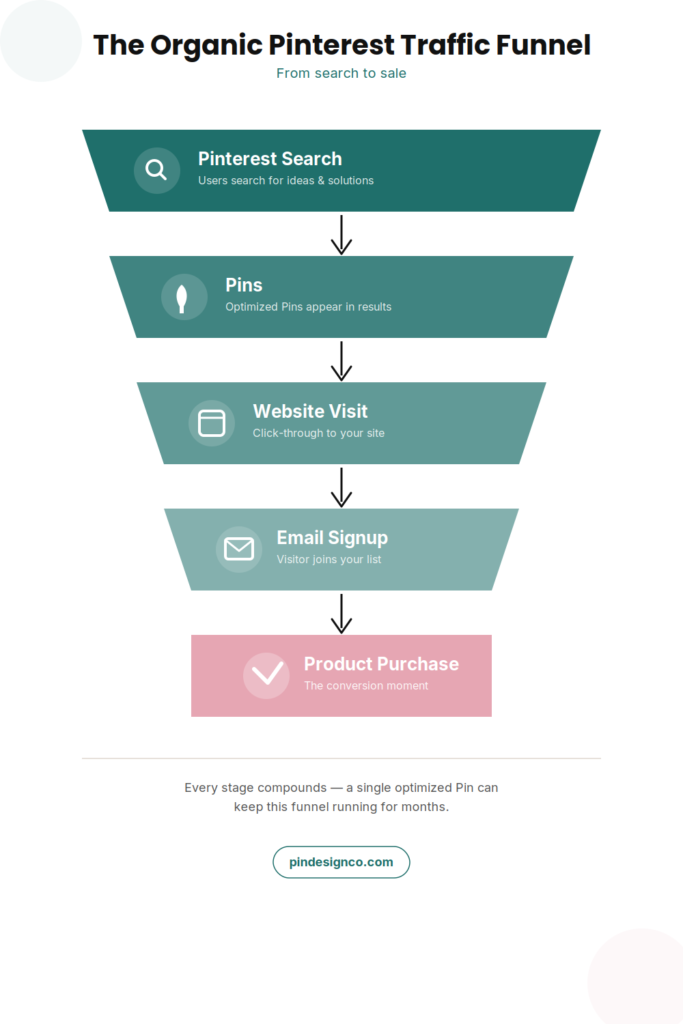
Pinterest SEO is one of the most underrated growth channels available to small businesses today. Because Pinterest functions as a visual search engine, keyword-optimized Pin titles, descriptions, and board names directly influence what your content ranks for — similar to how Google Search Central describes on-page optimization for websites.
Instagram, by contrast, has limited search functionality. Hashtags and captions help with discoverability, but Instagram’s algorithm prioritizes engagement signals over keyword relevance.
Traffic Generation
This is where the two platforms differ the most. Pinterest is built to send users off-platform — every Pin can link directly to a blog post, product page, or landing page. Instagram, especially organically, keeps users inside the app; only Stories (with the link sticker) and bio links offer direct click-through paths.
For businesses focused on organic traffic and blog traffic, Pinterest consistently outperforms Instagram.
Engagement
Instagram wins here. Comments, DMs, shares, and saves create a sense of community that Pinterest doesn’t replicate in the same way. If your goal is relationship-building, audience loyalty, and two-way conversation, Instagram is the stronger platform.
Lead Generation
Both platforms can generate leads, but differently:
- Instagram — through DMs, Stories link stickers, and relationship-driven trust
- Pinterest — through blog traffic funneling into email opt-ins, lead magnets, and product pages
Ecommerce
Instagram Shopping and Pinterest Shopping both support product tagging, but the intent differs. Instagram purchases are often impulse-driven, sparked by a Reel or influencer post. Pinterest purchases are often planned — users save products while researching, then return to buy later, which makes Pinterest especially strong for higher-consideration purchases.
Digital Products
For digital product sellers — Canva templates, printables, courses, ebooks — Pinterest tends to outperform Instagram because buyers are actively searching for solutions (“Canva Pinterest templates,” “editable planner,” “SEO checklist”) rather than passively scrolling.
Affiliate Marketing
Pinterest allows direct affiliate links on Pins (subject to platform policy and disclosure requirements), and its search-driven traffic pairs well with affiliate content. Instagram affiliate marketing typically relies on link-in-bio tools and Stories, since Feed posts don’t support clickable links.
Blogging
Pinterest remains one of the top referral traffic sources for bloggers, particularly in recipes, home, lifestyle, and business niches. Instagram can support a blog’s brand presence but rarely drives comparable click-through traffic.
B2B Marketing
Instagram has an edge for B2B brands that rely on visibility, thought leadership, and personal branding (via Reels, carousels, and behind-the-scenes content). Pinterest can still work for B2B in visually-driven niches (templates, design services, education), but it’s a smaller opportunity overall.
Service Businesses
Coaches, consultants, and service providers often use Instagram for trust-building and personal connection, while using Pinterest to drive traffic to lead magnets, webinars, and service pages — a combination that plays to each platform’s strengths.
Full Comparison Table
| Feature | ||
|---|---|---|
| Platform type | Social media | Visual search engine |
| Best for | Community, engagement, brand personality | Traffic, SEO, evergreen discovery |
| Content lifespan | 24–48 hours | Months to years |
| New account reach | Low | High |
| SEO impact | Limited | Significant |
| Traffic to website | Limited (organic) | Strong |
| Buyer intent | Often impulse-driven | Often planning-driven |
| Algorithm driver | Engagement & recency | Relevance & keywords |
| Content format | Photos, Reels, Stories, carousels | Static Pins, Idea Pins, video Pins |
Pros and Cons of Instagram
Pros
- Strong for real-time engagement and community
- Great for building a recognizable personal brand
- Reels can reach new audiences quickly when they perform well
- Direct messaging supports relationship-based selling
Cons
- Short content lifespan means constant content production
- Reach is unpredictable and algorithm-dependent
- Weak organic link-out capability
- High competition for attention in a crowded feed
Pros and Cons of Pinterest
Pros
- Long content lifespan — Pins keep working after publishing
- Strong organic traffic potential, even for new accounts
- Search-based discovery rewards good Pinterest SEO
- Users are often ready to click, save, or buy
Cons
- Slower to build engagement or two-way community
- Requires understanding of Pinterest SEO to perform well
- Less effective for real-time promotions or announcements
- Visual design quality directly affects click-through rate
Which Platform Is Better For…
| Business Type | Better Platform | Why |
|---|---|---|
| Bloggers | Long-term referral traffic and search-based discovery | |
| Etsy Sellers | High buyer intent and strong product discovery | |
| Shopify Stores | Both | Instagram for brand trust, Pinterest for planned purchases |
| Coaches | Instagram (primary), Pinterest (traffic) | Trust-building favors Instagram; Pinterest drives leads |
| Agencies | Visibility and thought leadership drive B2B trust | |
| Small Businesses | Lower competition, longer content lifespan, better ROI on time | |
| Local Businesses | Community connection matters more than search traffic | |
| Digital Product Creators | Buyers actively search for templates, printables, and tools |
Can You Use Both Together?
Yes — and for most businesses, this is the smartest long-term approach. Instagram and Pinterest aren’t competitors for your attention; they serve different stages of your customer’s journey.
A simple way to think about it:
- Instagram builds trust and relationship with your audience
- Pinterest drives new visitors to your website, content, or products
A Combined Pinterest + Instagram Marketing Strategy
- Create content once, repurpose across both platforms. A blog post can become a Pinterest Pin and an Instagram carousel or Reel.
- Use Instagram to build authority, then direct engaged followers to a lead magnet or product hosted on your website.
- Use Pinterest to drive consistent, compounding traffic to that same website — where your Instagram-built trust and your Pinterest-driven visitors meet.
- Track performance separately. Instagram KPIs (engagement rate, saves, DMs) are not the same as Pinterest KPIs (impressions, outbound clicks, saves).
- Let Pinterest SEO guide your content topics. Keyword research on Pinterest often reveals what people are actively searching for — useful input for blog and Instagram content too.
For businesses that don’t have the bandwidth to manage both platforms strategically, working with a dedicated Pinterest Management Services provider allows Instagram to stay focused on community while Pinterest quietly compounds traffic in the background.
Common Mistakes Businesses Make
- Treating Pinterest like Instagram — reposting Instagram graphics without Pinterest-specific sizing, keywords, or titles
- Ignoring Pinterest SEO — publishing Pins with no keyword strategy in titles or descriptions
- Expecting instant results on Pinterest — Pinterest is a compounding channel, not an overnight one
- Over-posting on Instagram without a content system — leading to burnout and inconsistent quality
- Not linking Pins to relevant, optimized landing pages — losing potential traffic and conversions
- Neglecting board strategy — poorly organized boards make it harder for Pinterest to understand and rank your content
Expert Tips
- Start every Pinterest campaign with Pinterest Keyword Research — it should shape your titles, descriptions, and board structure.
- Design Pins for Pinterest, not for Instagram. Vertical, text-friendly designs consistently outperform repurposed square graphics.
- On Instagram, prioritize saves and shares over likes — these signals carry more algorithmic weight.
- Audit your Pinterest Analytics Guide monthly to identify which Pins are driving outbound clicks, and create more content around those topics.
- If you’re just getting started, review Pinterest Business Account Setup to make sure your foundation — rich Pins, claimed website, business profile — is set up correctly before scaling content.
Frequently Asked Questions
Is Pinterest better than Instagram for driving website traffic?
Yes, generally. Pinterest is designed to send users off-platform to websites, while Instagram is designed to keep users within the app, which naturally limits organic click-through traffic.
Is Instagram better than Pinterest for engagement?
Yes. Instagram’s comment, share, and DM features create stronger two-way interaction, making it better suited for community-building and relationship-based marketing.
Can a small business succeed with only Pinterest?
Yes, particularly bloggers, digital product sellers, and ecommerce brands, since Pinterest doesn’t require a large following to gain visibility.
Does Pinterest count as social media?
Pinterest is technically classified as a social platform, but it functions more like a visual search engine, since discovery is driven by keywords and user intent rather than social interaction.
How long does it take to see results on Pinterest?
Most businesses start seeing meaningful traffic within 3–6 months of consistent, SEO-optimized posting, with results typically compounding after that.
Do I need a large following to succeed on Pinterest?
No. Pinterest reach is based on content relevance and SEO, not follower count, which is one of its biggest advantages for new accounts.
Is Instagram engagement declining?
Organic reach on Instagram has become more competitive as the platform prioritizes Reels and paid content, making consistent organic growth harder without a clear content strategy.
Which platform is better for ecommerce brands?
Both can work well together — Instagram for brand storytelling and product launches, Pinterest for planned purchases and sustained product discovery.
Should I hire someone to manage Pinterest for my business?
If you don’t have the time to research keywords, design optimized Pins, and monitor analytics consistently, working with a Pinterest Marketing Services provider can help you build traffic without adding it to your own plate.
Can I repurpose Instagram content for Pinterest?
Yes, but it should be adapted — resized to Pinterest’s vertical format, retitled with keywords, and given a Pinterest-optimized description rather than posted as-is.
Final Verdict
There’s no single winner here — the “better” platform depends entirely on your goal.
- If you want traffic, SEO, and long-term compounding growth, prioritize Pinterest.
- If you want engagement, community, and brand personality, prioritize Instagram.
- If you want a complete marketing system, use both — with Pinterest as your traffic engine and Instagram as your trust-building layer.
Conclusion
Instagram and Pinterest aren’t really competing platforms — they’re complementary tools that serve different parts of your marketing funnel. Instagram helps people fall in love with your brand. Pinterest helps new people find you in the first place, often months after you hit publish.
If you’re not sure where to start, Pinterest is usually the higher-leverage investment for driving consistent, compounding traffic — especially for bloggers, digital product sellers, and small businesses with limited time to spend on content each week.
If you’d like help building a Pinterest strategy that actually drives traffic — without guessing at keywords or Pin design — explore PinDesignCo’s Pinterest SEO Services and Pinterest Management Services to see how a done-for-you approach could work for your business.