Most people who start using Pinterest for business run into the same wall. They know they’re supposed to post consistently, but they don’t know what to post, which topics to prioritize, how many Pins to create, or what to do when a Pin sits there with almost no saves.
That confusion isn’t a sign you’re doing something wrong. It’s a sign you don’t have a Pinterest content strategy yet.
A content strategy turns Pinterest from a place where you post whatever comes to mind into a system with a clear purpose: the right content, for the right audience, organized around the right keywords, published on a schedule you can actually maintain. This guide walks through that full system — research, planning, creation, optimization, publishing, and analysis — so you can go from random posting to a repeatable process.
Table of Contents
What Is a Pinterest Content Strategy?
A Pinterest content strategy is a structured plan for deciding what you create, who it’s for, and how it gets in front of the right people on Pinterest.
At a minimum, it defines:
- What content you’ll create and how often
- Who that content is for
- Which topics and keywords you’ll target
- Which boards each Pin belongs on
- What your Pins will look like
- When you’ll publish
- How you’ll measure whether it’s working
- How you’ll adjust based on what you learn
It’s worth separating this from two terms people tend to use interchangeably.
Pinterest content strategy is about what you create and why — your topics, formats, and publishing plan.
Pinterest marketing strategy is the bigger picture — how Pinterest fits into your overall business goals, including paid promotion, audience building, and how Pinterest supports revenue.
Pinterest SEO is about how discoverable that content is — the keywords, titles, and descriptions that help Pinterest understand and surface your Pins in search.
Content strategy, SEO, and marketing strategy work together. Content strategy gives you something worth optimizing. SEO makes sure it gets found. Marketing strategy connects it back to business results.
Why Is a Pinterest Content Strategy Important?
Pinterest behaves more like a visual search engine than a social feed. People search it the way they’d search Google — looking for ideas, products, or answers — and A well-optimized Pin can continue appearing in Pinterest search and discovery surfaces long after you publish it.
That changes how you should think about content. A strategy gives you:
- Consistency. You’re not staring at a blank screen deciding what to post each week.
- Better keyword targeting. Content is planned around what people are actually searching for, not guesswork.
- More relevant Pins. Each Pin has a clear purpose and audience instead of being a generic promotion.
- Organized boards. Pins land in the right place, which helps both Pinterest and your audience understand your content.
- More visibility over time. Search-optimized Pins can continue earning impressions long after publishing.
- Better use of existing content. One blog post or product page can generate several Pins instead of one.
- Clear performance tracking. You know which topics and formats are pulling their weight.
Without a strategy, it’s easy to fall into a pattern of posting whatever feels urgent that day. With one, every Pin has a reason to exist.
How to Create a Pinterest Content Strategy Step by Step
1. Define Your Pinterest Goals
Before planning any content, get specific about what you want Pinterest to do for your business. Common goals include:
- Driving traffic to a blog
- Growing an email list
- Selling digital products
- Generating affiliate income
- Supporting a service-based business
- Building brand awareness in a niche
A blogger monetizing through ads needs consistent traffic to older and newer posts. A shop selling Canva templates needs Pins that lead directly to product listings. Your goal shapes everything downstream — which topics you prioritize, what your Pins say, and where they send people.
2. Define Your Target Audience
Pinterest users search with intent, so understanding who you’re creating for matters more here than on most platforms. Get clear on:
- Who they are (role, stage of business, interests)
- What they’re searching for on Pinterest
- What problem they’re trying to solve
- What they’d realistically save or click on
For example, a Pinterest account for a productivity coach might target “small business owners overwhelmed by their to-do list,” who search for terms like “daily planner ideas” or “time management for entrepreneurs” — not generic productivity content aimed at everyone.
3. Choose Your Main Content Topics
Once you know your goal and audience, group your content into topic clusters instead of picking topics one at a time. A Pinterest marketing business, for instance, might build clusters around:
- Pinterest SEO
- Pinterest keyword research
- Pinterest Pin design
- Pinterest content strategy
- Pinterest analytics
- Pinterest boards
- Pinterest growth
Working in clusters prevents the common trap of creating disconnected one-off content that never builds authority on any single topic.
4. Conduct Pinterest Keyword Research
Keyword research is what turns your topic clusters into specific, searchable content ideas. Rather than guessing at titles, look at Pinterest search suggestions, Pinterest Trends, and related long-tail phrases to understand what your audience is actually typing into Pinterest search — and what intent sits behind those searches.
This step feeds directly into your content plan: every article, Pin idea, and board should trace back to a real keyword someone is searching for. For a full walkthrough of finding and prioritizing keywords, see our Pinterest keyword research guide.
5. Build Content Around Search Intent
Not every Pinterest search has the same intent, and your content should match it. A few common types:
- Informational — “what is Pinterest SEO”
- Inspirational — “cozy living room ideas”
- Problem-solving — “how to grow Pinterest followers fast”
- Commercial — “best Canva templates for bloggers”
- Product-focused — “Pinterest planner template”
Take the keyword “Pinterest content strategy” as an example. Depending on intent, that could become several different pieces of content: a complete strategy guide, a content calendar template, a list of content ideas, or a planning checklist. Matching the format to the intent is what makes content actually useful instead of just present.
6. Create Content Pillars for Pinterest
Content pillars are the 3–5 broad categories every piece of content should fall under. For a Pinterest marketing brand, that might look like:
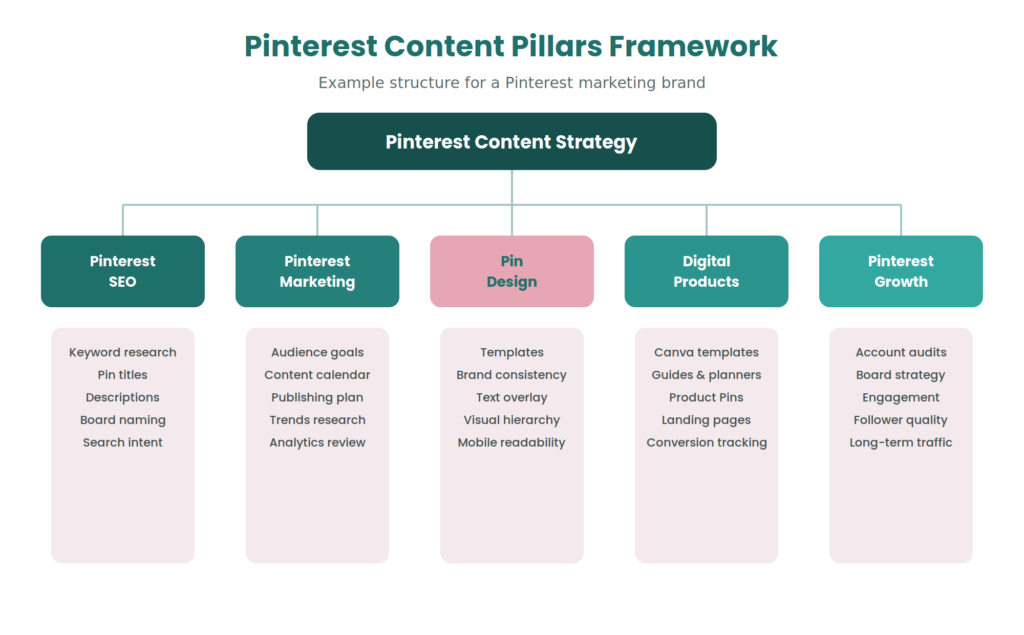
- Pinterest SEO
- Pinterest Marketing
- Pinterest Pin Design
- Digital Products
- Pinterest Growth
Every new blog post, Pin idea, or content request gets checked against these pillars first. If it doesn’t fit, it’s either reshaped to fit or set aside — this is what keeps a content library focused instead of scattered.
7. Turn One Blog Post Into Multiple Pinterest Pins
This is one of the most underused strategies on Pinterest. A single blog post can support several Pins, each with a different angle, hook, and design — all pointing to the same URL.
Take a post about Pinterest content strategy. From that one article, you could create:
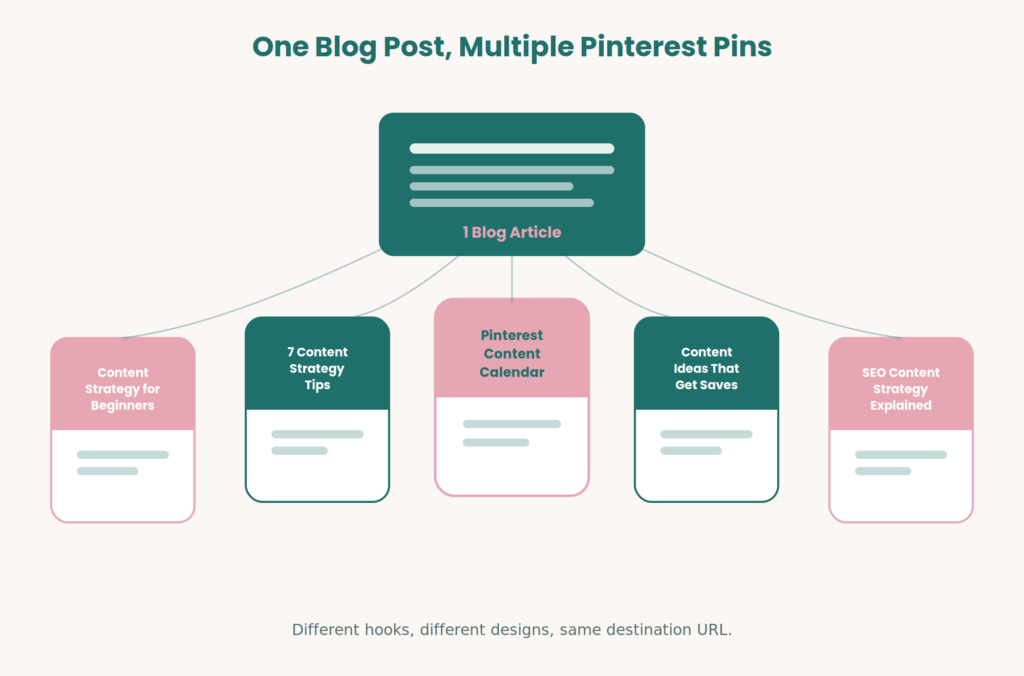
- “Pinterest Content Strategy for Beginners”
- “7 Pinterest Content Strategy Tips”
- “How to Plan Your Pinterest Content Calendar”
- “Pinterest Content Ideas That Actually Get Saves”
- “Pinterest SEO Content Strategy Explained”
Each Pin should genuinely differ in hook and design — not just a headline font swapped onto an identical image. Uploading near-duplicate Pins repeatedly works against you rather than for you.
8. Create a Pinterest Content Calendar
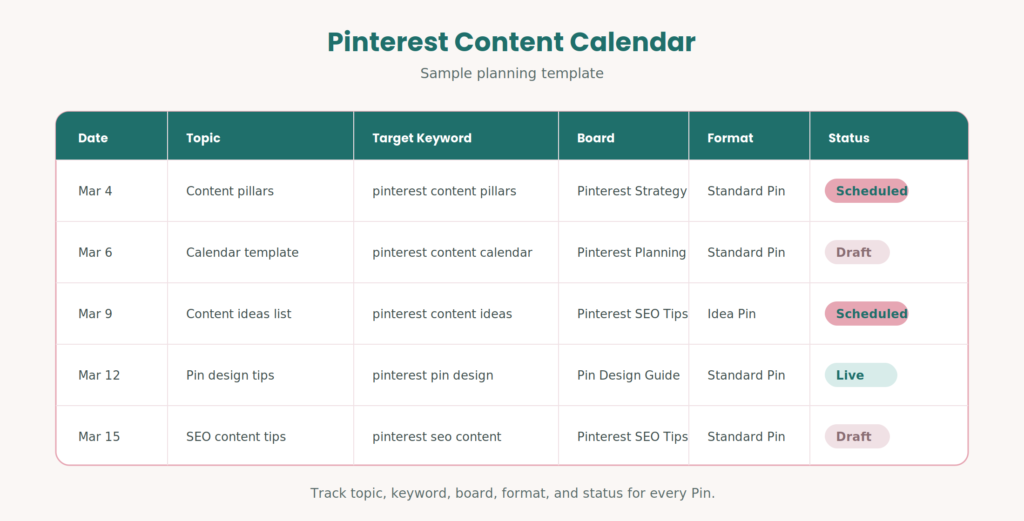
A content calendar keeps your strategy organized and prevents last-minute scrambling. A useful calendar tracks:
| Date | Content Topic | Target Keyword | Pin Title | Destination URL | Board | Pin Format | Status |
|---|---|---|---|---|---|---|---|
| Mar 4 | Content pillars for Pinterest | pinterest content pillars | How to Choose Pinterest Content Pillars | /pinterest-content-strategy/ | Pinterest Strategy | Standard Pin | Scheduled |
| Mar 6 | Content calendar template | pinterest content calendar | Free Pinterest Content Calendar Template | /pinterest-content-strategy/ | Pinterest Planning | Standard Pin | Draft |
You don’t need to fill months of content at once. A calendar that’s realistic and consistently maintained will outperform an ambitious one you abandon after two weeks.
9. Decide How Often to Post on Pinterest
There’s no single posting frequency that works for every account, and be wary of any advice that claims otherwise. How often you should publish depends on:
- How much genuinely original content you can create
- Your niche and audience size
- How established your account already is
- Your capacity to maintain quality over volume
Pinterest’s own guidance emphasizes creating fresh, original content on a consistent basis rather than reposting the same Pin over and over. You can learn more from Pinterest’s official business guidance. A sustainable schedule you can maintain for months will always outperform an aggressive one you abandon after a few weeks.
10. Optimize Every Pin for Pinterest SEO
Once content is planned, each Pin needs to be optimized so Pinterest can understand and surface it. This includes your Pin title, description, text overlay, board selection, and destination page — all working together around the topic and keyword the Pin targets.
Content strategy decides what to create; SEO makes sure it gets found. For the full breakdown of writing titles and descriptions that perform, see our Pinterest SEO best practices guide.
11. Create Better Pinterest Pin Designs
Design is what gets someone to stop scrolling and click. Strong Pins tend to share a few traits:
- A clear, readable headline
- Obvious visual hierarchy — the eye knows where to look first
- Text that’s legible on a small mobile screen
- A vertical layout (2:3 ratio works best)
- Consistent brand colors and fonts
- One clear message per Pin, not several competing ideas
Good design supports your content strategy rather than replacing it — a beautifully designed Pin for the wrong topic still won’t perform. For a deeper look at building Pins that convert, see our Pinterest Pin design guide.
12. Use Seasonal and Evergreen Content
A balanced content strategy includes both:
Evergreen content — stays relevant year-round, such as Pinterest SEO tips, Canva template roundups, or general marketing advice.
Seasonal content — tied to specific times of year, such as Christmas gift guides, Valentine’s Day content, back-to-school ideas, or New Year planning content.
Pinterest users tend to plan ahead of major seasons and holidays, often searching for ideas well before the date itself. Publishing seasonal content early — rather than the week of the event — gives it more time to gain traction before demand peaks.
13. Use Pinterest Trends to Find Content Opportunities
Pinterest Trends and Pinterest Predicts can surface rising topics, seasonal shifts, and search terms gaining momentum before they peak. Checking these regularly can shape which topics you prioritize next, which keywords to target, and when to schedule seasonal content — turning your content calendar into something responsive rather than static.
14. Measure Your Pinterest Content Strategy
Once content is live, tracking performance tells you what’s working and what isn’t. Key metrics to watch:
- Impressions
- Saves
- Pin clicks
- Outbound clicks
- Engagement rate
- Top-performing Pins and topics
- Website traffic from Pinterest
- Conversions, where applicable
Impressions alone don’t tell the full story. A Pin can rack up thousands of impressions and still generate almost no traffic if it’s not compelling enough to click. If your goal is website traffic, product sales, or leads, track those outcomes specifically rather than relying on impressions as a proxy for success.
15. Update Your Pinterest Content Strategy Based on Data
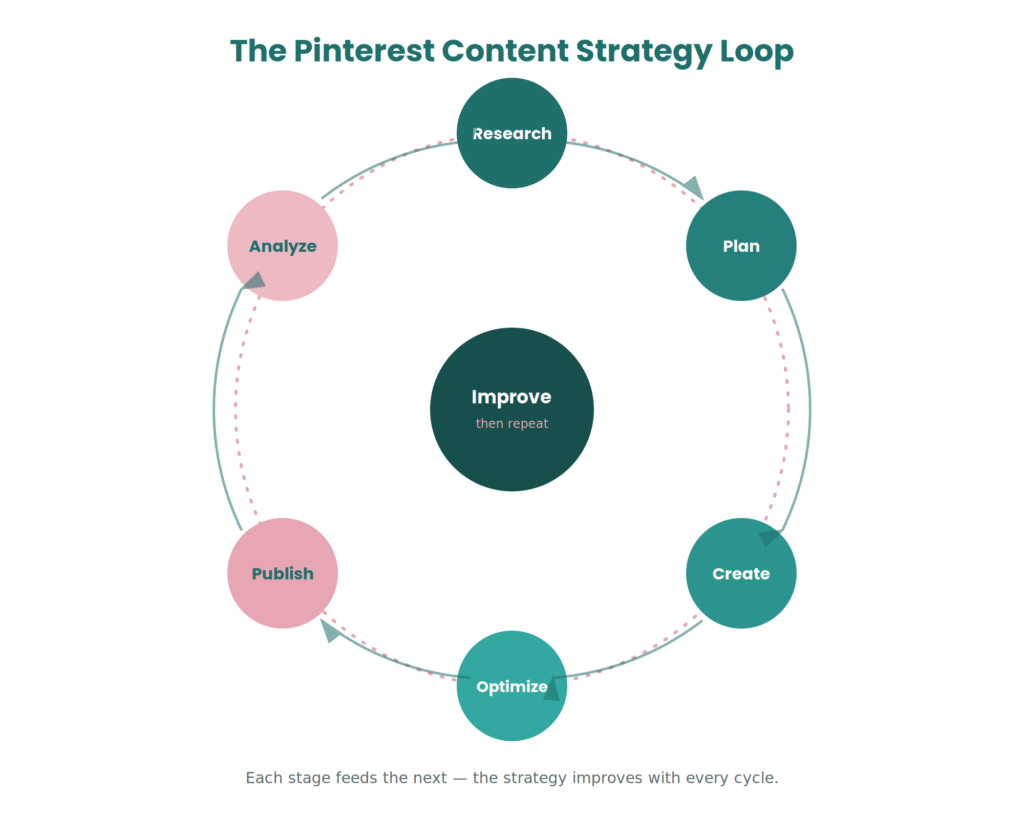
A content strategy isn’t something you set once and forget. The loop looks like this: publish, measure, learn, improve, create more.
Over time, patterns emerge — certain topics consistently get saved, certain keywords bring steady impressions, certain designs get more clicks than others. Feed those patterns back into your content pillars and calendar so your strategy keeps improving instead of staying frozen at whatever you decided in month one.
Pinterest Content Strategy Example
Here’s how the full process connects, using a Pinterest marketing content pillar as an example:
- Content Pillar: Pinterest SEO
- Keyword: Pinterest keyword research
- Article: Pinterest Keyword Research Guide
- Pin ideas: “How to Find Pinterest Keywords,” “Pinterest Keyword Research for Beginners,” “7 Pinterest Keyword Research Tips”
- Board: Pinterest SEO Tips
- CTA: Link to a related service or lead magnet
Each layer connects back to the one before it — the pillar defines the topic, the keyword defines the specific angle, and the Pins give that one article multiple entry points into Pinterest search.
Pinterest Content Strategy Template
A simple, reusable framework you can apply to any niche:
Goal → Audience → Content Pillars → Keywords → Content → Pins → Publishing Schedule → Analytics → Optimization
Paired with a lightweight content calendar (see the table above), this template scales from a brand-new account to an established one — you’re just filling in more detail as you go.
Common Pinterest Content Strategy Mistakes
| Mistake | Why It Hurts | How to Fix It |
|---|---|---|
| Posting without a plan | Content feels random and inconsistent | Build content pillars before creating Pins |
| Targeting random keywords | Pins don’t match what people search | Base topics on real keyword research |
| Creating duplicate Pins | Create genuinely different Pins with distinct hooks, visuals, and angles. | Vary hooks and designs for each Pin |
| Chasing impressions only | Doesn’t reflect real business results | Track clicks, traffic, and conversions |
| Ignoring search intent | Content mismatches what the searcher wants | Match content format to intent |
| Reusing the same hook | Reduces click-through over time | Test different angles and headlines |
| Prioritizing volume over quality | Weak content underperforms regardless of frequency | Publish less, but make it count |
| Skipping analytics | You keep repeating what isn’t working | Review performance monthly and adjust |
| Linking to unhelpful pages | Increases bounce, hurts conversions | Send traffic to relevant, useful pages |
| Switching niches frequently | Confuses Pinterest and your audience | Stay consistent within your pillars |
Pinterest Content Strategy vs. Pinterest SEO
| Content Strategy | Pinterest SEO | |
|---|---|---|
| Focus | What you create and why | How discoverable that content is |
| Covers | Topics, pillars, calendar, formats | Keywords, titles, descriptions, boards |
| Goal | A consistent, organized content system | Getting content found in Pinterest search |
| Relationship | Provides the content worth optimizing | Makes that content searchable |
Neither replaces the other. A brilliant strategy with poor SEO won’t get discovered. Strong SEO applied to unfocused content won’t hold anyone’s attention once they click.
How Pinterest Content Strategy Supports Business Growth
A consistent, well-organized Pinterest content strategy becomes a long-term traffic system rather than a short-term push. Over time, it can support:
- Steady blog traffic from search-optimized Pins
- Email list growth through lead magnets promoted via Pins
- Digital product sales through Pins linked directly to listings
- Affiliate income through relevant, well-placed content
- Awareness that compounds as more Pins accumulate impressions
Results vary by niche, consistency, and content quality — there’s no fixed timeline or guaranteed outcome. But a strategy gives your Pinterest presence direction, which random posting never will.
If managing this process alongside running your business feels like a lot, that’s exactly the kind of ongoing planning our Pinterest management services and Pinterest SEO services are built to handle.
Frequently Asked Questions
What is a Pinterest content strategy?
It’s a structured plan for what content you create on Pinterest, who it’s for, which keywords and boards it targets, and how you’ll measure and improve its performance over time.
How do I create a content strategy for Pinterest?
Start by defining your goals and audience, then build content pillars, research keywords, plan a calendar, create and optimize Pins, publish consistently, and adjust based on performance data.
What should I post on Pinterest?
Content that fits your defined content pillars and matches real search intent — informational guides, inspirational ideas, product-focused Pins, or problem-solving content, depending on your goals.
How often should I post on Pinterest?
There’s no universal number that works for everyone. Focus on a schedule you can consistently maintain with genuinely original content, rather than chasing a specific daily quota.
What is a Pinterest content calendar?
A planning tool that tracks upcoming Pins, their target keywords, destination URLs, boards, and publishing status, so your content stays organized and consistent.
How do I find content ideas for Pinterest?
Use Pinterest search suggestions, Pinterest Trends, and keyword research to identify what your audience is actively searching for, then match those topics to your content pillars.
How does Pinterest SEO fit into content strategy?
Content strategy decides what you create; Pinterest SEO makes sure that content is discoverable through optimized titles, descriptions, and keywords.
How can I measure Pinterest content performance?
Track impressions, saves, clicks, and outbound traffic in Pinterest Analytics, but weigh clicks and conversions more heavily than impressions alone.
Final Thoughts
A Pinterest content strategy isn’t a one-time document — it’s a repeatable loop: research, plan, create, optimize, publish, analyze, and improve. Each cycle gives you more data on what your audience actually responds to, which makes the next round of content easier to plan.
If you’re just getting started, don’t try to build the entire system in one sitting. Pick your goal, define a few content pillars, and create your first handful of Pins from there. The strategy will keep sharpening itself as you go.
If you’d rather have this entire process — planning, keyword research, Pin design, and publishing — handled for you, our Pinterest management services are built around exactly this kind of ongoing content system.