Table of Contents
Pinterest works differently than every other platform you’ve tried to grow an income on. It isn’t a social network where your content disappears in a day. It’s a visual search engine, closer in spirit to Google than to Instagram or TikTok. A single pin, optimized well, can keep sending clicks to your affiliate links for months or even years after you hit publish.
That’s what makes Pinterest such a strong fit for affiliate marketing. You’re not chasing algorithms that reward you for showing up every hour. You’re building a searchable library of content that compounds over time.
In this guide, you’ll learn exactly what Pinterest affiliate marketing is, how the process works from start to finish, which affiliate programs are worth your time, and how to avoid the mistakes that keep most beginners from ever seeing a payout. We’ll also cover realistic timelines, so you know what to expect instead of chasing shortcuts that don’t exist.
What Is Pinterest Affiliate Marketing?
Affiliate marketing is a simple arrangement: you promote a product using a unique tracking link, and when someone buys through that link, you earn a commission. No inventory, no customer service, no shipping.
Pinterest’s role in this is to act as the discovery layer. Instead of relying on an email list or existing blog traffic, you create pins that people find while searching Pinterest for ideas, products, or solutions to a problem. Someone searching “capsule wardrobe basics” or “meal prep containers” is often in buying mode, actively looking for recommendations, not just browsing.
Here’s a simple example. Say you run a home organization account. You write a blog post on “10 Best Storage Bins for Small Closets,” including affiliate links to specific products. You then design several pins for that post, each targeting slightly different keywords like “small closet organization” or “closet storage ideas.” Pinterest surfaces those pins to people actively searching those terms. Some click through to your article, and a portion of those readers buy through your affiliate links.
The reason this model works well for beginners is that Pinterest doesn’t require an existing audience. Your pins can rank in search results and get discovered by people who have never heard of you, which is very different from platforms where growth depends on an established following.
Can You Really Make Money on Pinterest?
Yes, but with realistic expectations. Pinterest affiliate marketing is not a get-rich-quick tactic, and anyone promising fast, guaranteed income is skipping over how the platform actually works.
What’s realistic:
- Organic traffic takes time to build. Pinterest’s algorithm needs to understand your content and start distributing it to the right searchers, which typically happens gradually rather than overnight.
- Growth compounds. Unlike a tweet or an Instagram post, a well-optimized pin can continue to be discovered and clicked long after you published it, since Pinterest content behaves more like evergreen search content than a social feed post.
- Income scales with consistency and quality, not with how “viral” a single pin goes. A steady library of 50–100 well-optimized pins tends to outperform a handful of pins you posted once and forgot about.
- Passive income is achievable, but it’s built, not found. The “passive” part comes after the upfront work of creating content, designing pins, and optimizing for search.
If you’re consistent with quality content and Pinterest SEO, Pinterest can become one of the more sustainable traffic sources for affiliate income, specifically because of how long pins stay discoverable compared to other platforms.
How Pinterest Affiliate Marketing Works
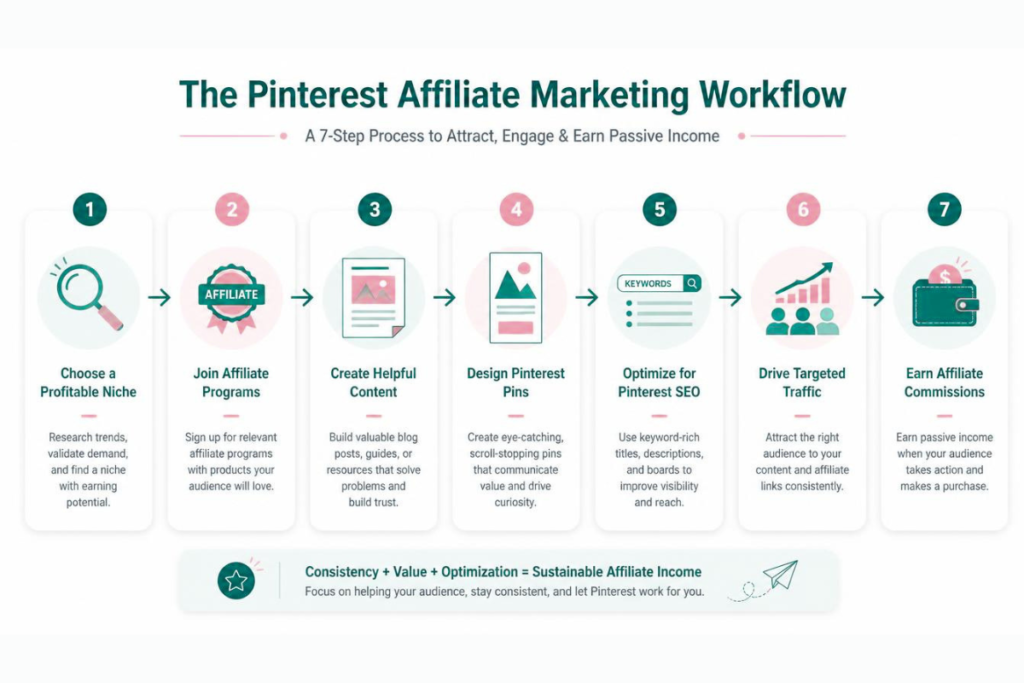
Here’s the full process from start to finish, as a simple workflow:
- Choose a niche — a specific topic area you’ll consistently create content around.
- Join affiliate programs relevant to that niche.
- Create valuable content — usually a blog post, resource, or landing page — that naturally features the products you’re promoting.
- Design Pinterest pins that represent that content visually.
- Optimize pins for Pinterest SEO so they can be found in search.
- Drive traffic to your content through consistent publishing.
- Generate affiliate commissions as readers click through and purchase.
Each step depends on the one before it. Skipping niche research leads to scattered content that never builds authority. Skipping pin design leads to low click-through rates even if your SEO is solid. The steps below break down exactly how to execute each stage.
What You Need Before You Start
Before diving into content creation, get these basics in place:
- A Pinterest Business Account — required for access to analytics, Rich Pins, and other features not available on personal accounts.
- A website or blog (strongly recommended) — while some affiliate programs allow direct linking from Pinterest, most affiliate programs and Pinterest’s own policies favor sending traffic to a piece of content first, rather than a bare affiliate link.
- At least one approved affiliate program in your niche.
- A working understanding of Pinterest SEO — keyword research, pin titles, and descriptions matter as much as the visuals.
- A design tool like Canva for creating pins efficiently and consistently.
- Access to Pinterest Analytics to track what’s actually working.
You don’t need all of this perfected on day one, but you do need each piece in place before you can realistically expect results.
How to Start Pinterest Affiliate Marketing (Step-by-Step)
Choose a Profitable Niche
Pick a niche that has three things: genuine buyer intent, enough products or services to promote long-term, and enough personal interest or knowledge that you can create content consistently without burning out. Home decor, personal finance, beauty, fitness, parenting, and digital products are all strong categories on Pinterest because people search Pinterest specifically to find product recommendations and ideas in these spaces.
Avoid picking a niche solely because it looks profitable. If you can’t sustain content creation in it for a year, the niche isn’t the right fit.
Find Affiliate Programs
Search for affiliate programs directly tied to your niche, and also check affiliate networks (like the ones covered in the comparison table below), which host multiple brands under one dashboard. Look for programs with:
- A cookie duration long enough to capture delayed purchases
- Clear payout terms and a reasonable payment threshold
- Products you’d genuinely recommend, since Pinterest audiences respond to authentic, useful recommendations far more than obvious sales pitches
Create Helpful Content
Your blog post, guide, or landing page should answer the reader’s question or solve their problem before it introduces the affiliate product. Lead with value. A “best products for X” list, a tutorial, or a comparison article all work well because they naturally accommodate affiliate links without feeling forced.
Design Click-Worthy Pinterest Pins
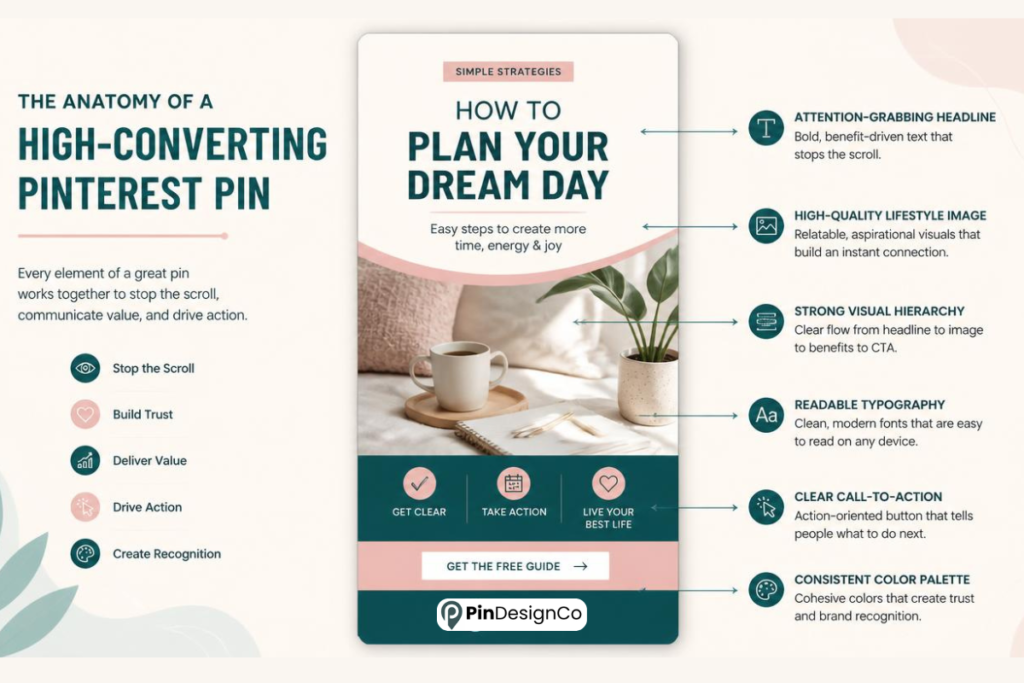
Pins need to stop the scroll while staying true to what the content actually delivers. Effective pins typically include:
- A clear, readable headline text overlay
- High-contrast colors that stand out in the feed
- A vertical format (2:3 aspect ratio performs best on Pinterest)
- Branding that’s consistent but not distracting
Design multiple pin variations for the same piece of content to test what resonates.
Write SEO-Optimized Pin Titles
Your pin title should include your target keyword naturally, near the beginning where possible, while still reading like something a human would actually click. “10 Budget Storage Bins for Small Closets” works better than a title stuffed with keywords and no personality.
Write Keyword-Rich Pin Descriptions
Pin descriptions give Pinterest more context about what your content covers. Include your primary keyword plus two or three related terms, written as natural sentences rather than a keyword list. This is also where you can briefly explain the value the reader will get by clicking through.
Publish Consistently
Pinterest tends to reward accounts that publish new pins regularly over accounts that post in bursts and go quiet. A steady, sustainable publishing rhythm — even a modest one — outperforms sporadic activity in the long run.
Analyze Performance
Check Pinterest Analytics regularly to see which pins are getting impressions, saves, and outbound clicks. Double down on the content types, formats, and topics that are already performing, and retire or redesign the ones that aren’t.
Best Affiliate Programs for Pinterest
| Program | Best For | Commission | Cookie Duration | Notes |
|---|---|---|---|---|
| Amazon Associates | Beginners, broad product ranges | Low, category-dependent | Short (typically 24 hours) | Huge product selection; rates and terms change often, so check current terms before joining |
| ShareASale | Small-to-mid brands, niche products | Varies by merchant | Varies by merchant | Large network with brands in home, fashion, and lifestyle |
| Impact | Established and DTC brands | Varies by merchant | Varies by merchant | Clean dashboard, good for scaling across multiple brands |
| CJ Affiliate (Commission Junction) | Larger, well-known retailers | Varies by merchant | Varies by merchant | Application approval can be stricter for newer publishers |
| PartnerStack | SaaS and software products | Often higher, recurring options | Varies by merchant | Strong fit if your niche overlaps with tools or software |
| Awin | International brands, UK/EU focus | Varies by merchant | Varies by merchant | Useful if you’re targeting UK or Australian audiences |
Commission rates, cookie durations, and program terms change frequently. Always confirm current details directly on each program’s official site before joining or promoting.
Pinterest SEO Tips for Affiliate Marketing
- Keyword research first. Use Pinterest’s own search bar and guided search suggestions to find the terms your audience is actually typing in.
- Front-load pin titles with keywords, but keep them natural and readable.
- Write full-sentence descriptions that include your primary keyword plus related terms.
- Optimize your boards, not just individual pins — board titles and descriptions contribute to how Pinterest understands your account’s topics.
- Use Rich Pins where applicable, since they pull in extra metadata from your website and can improve credibility and click-through.
- Optimize images, including file names, so they carry SEO value beyond the pin description alone.
- Plan for seasonal content ahead of time — Pinterest search behavior shifts by season, often earlier than other platforms, so seasonal pins need to go up well before peak demand.
- Publish fresh pins regularly rather than only recycling the same graphic for existing content.
- Link internally between related blog content to keep visitors engaged once they land on your site, which also supports your site’s own topical authority.
Common Pinterest Affiliate Marketing Mistakes
- Spamming affiliate links — Dropping raw affiliate links directly into pins or descriptions without context feels spammy and typically underperforms. Lead with content, not the link.
- Ignoring Pinterest SEO — Beautiful pins with no keyword strategy behind them won’t get discovered. Treat pin titles and descriptions with the same care as a blog post’s SEO.
- Using poor-quality graphics — Blurry images, cluttered text, or inconsistent branding reduce trust and click-through rates.
- Inconsistent posting — Sporadic bursts of activity followed by silence make it harder for Pinterest to understand and distribute your content.
- Choosing the wrong niche — A niche with no genuine buyer intent, or one you can’t sustain content for, will stall your growth regardless of effort elsewhere.
- Not testing pins — Publishing one pin design per piece of content and never revisiting it means missing easy wins from a better headline or image.
- Ignoring analytics — Without checking what’s actually working, you end up guessing instead of doubling down on proven content.
Pinterest Affiliate Marketing Without a Blog
It is possible to do affiliate marketing on Pinterest without a full blog, though it comes with tradeoffs.
Is it possible? Yes. Some affiliate programs and Pinterest’s own guidelines allow direct affiliate links on pins, provided they’re clearly disclosed and comply with both the affiliate program’s terms and Pinterest’s policies.
Advantages: Lower barrier to entry, faster to set up, and no need to maintain a website.
Limitations: You lose the ability to add context, comparisons, or genuine value around the product before the click, which tends to reduce conversion rates. You also have less control if Pinterest or the affiliate network changes its direct-linking policies.
Best practices: If you go this route, be transparent about affiliate relationships, only promote products relevant to the pin’s content, and regularly review both Pinterest’s advertising and affiliate guidelines along with each affiliate program’s terms, since policies on direct linking do change.
Longer term, most successful Pinterest affiliate marketers eventually build at least a simple landing page or blog, because it gives more room to build trust and answer the reader’s questions before asking for the click.
How Long Does It Take to Make Money?
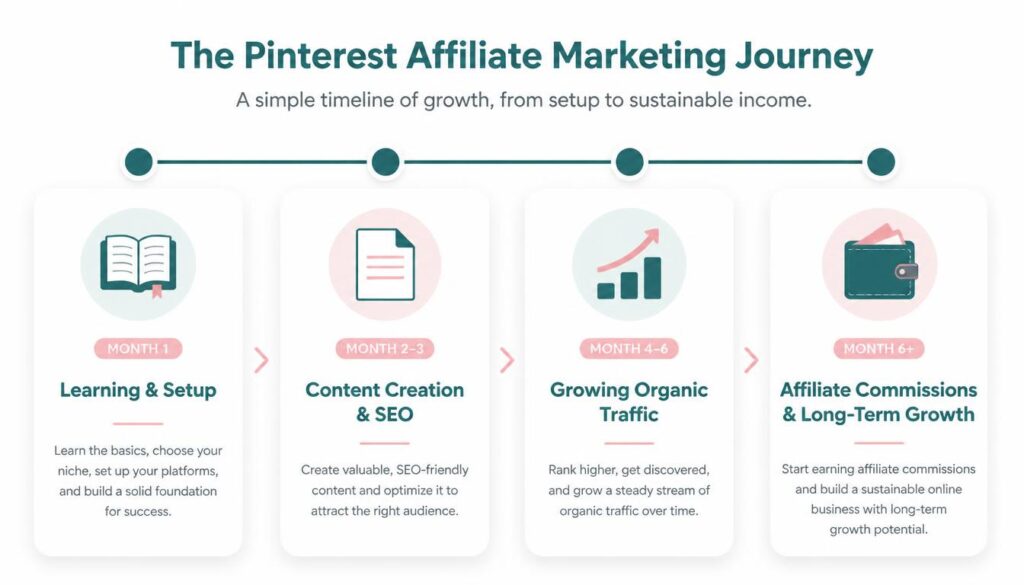
There’s no universal timeline, and anyone giving you an exact number of weeks or dollars is guessing. What’s realistic is understanding the phases most accounts go through:
- Learning phase — Understanding Pinterest SEO, your niche, and what content resonates. This is where most beginners either quit too early or start building real momentum.
- Traffic growth phase — As you publish consistently and Pinterest’s algorithm gathers more signals about your content, impressions and clicks typically start to trend upward.
- Consistency phase — This is where a library of pins starts working together, with older content continuing to generate traffic while new content adds to it.
- Long-term compounding — Accounts that stick with Pinterest SEO and consistent publishing for the long haul tend to see traffic — and affiliate income — become more stable and less dependent on any single pin performing well.
Don’t expect guaranteed results in a fixed timeframe. Focus on the inputs you control: content quality, consistency, and SEO.
Frequently Asked Questions
Do I need a lot of followers to make money with Pinterest affiliate marketing?
No. Pinterest functions more like a search engine than a social network, so your content can be discovered by new searchers regardless of your follower count.
Is Pinterest affiliate marketing free to start?
Yes, creating a Pinterest Business Account and joining most affiliate programs is free. Your main investment is time, and optionally, tools like Canva Pro or a website.
Can I put affiliate links directly on Pinterest pins?
Some affiliate programs and Pinterest’s guidelines allow this, but always check current program terms and Pinterest’s advertising policies first, since rules on direct linking can change.
How many pins should I post per day?
There’s no single magic number. Focus on consistency and quality over volume, and use Pinterest Analytics to see what publishing rhythm works for your account.
Which niche makes the most money on Pinterest?
Home decor, personal finance, beauty, fitness, and digital products tend to perform well because Pinterest users in these categories are often actively searching with purchase intent. That said, a niche you can sustain long-term will outperform a “hot” niche you abandon after a month.
Do I need my own website for Pinterest affiliate marketing?
It’s not strictly required, but it’s strongly recommended. A blog or landing page gives you room to build trust, add context, and improve conversions compared to a bare affiliate link.
How long until a pin starts getting traffic?
This varies by account, niche, and competition. Some pins pick up traction within weeks; others take longer as Pinterest’s algorithm gathers more data about your content and audience.
Can I use the same pin design for multiple platforms?
You can, but pins optimized specifically for Pinterest’s vertical format and search behavior tend to outperform graphics repurposed from other platforms.
Is Amazon Associates good for Pinterest affiliate marketing?
It can be a solid starting point due to its huge product range, though commission rates are often lower than niche-specific programs. Many creators use it alongside other programs rather than exclusively.
What’s the biggest mistake beginners make?
Prioritizing pin volume over Pinterest SEO and content quality. A smaller number of well-optimized, valuable pins usually outperforms a large volume of rushed ones.
Key Takeaways
- Pinterest functions as a visual search engine, meaning your content can be discovered and generate traffic long after you publish it.
- Success depends on the full workflow — niche, affiliate programs, content, pin design, and Pinterest SEO — not any single step alone.
- Choose a niche with real buyer intent and enough depth to sustain content long-term.
- A website or landing page gives you more room to build trust and convert clicks than affiliate links alone.
- Pinterest SEO — keyword research, pin titles, descriptions, and board optimization — is what makes your content discoverable.
- Consistency compounds. A steady library of optimized pins outperforms sporadic bursts of activity.
- Always verify current commission rates, cookie durations, and platform policies directly with each affiliate program before promoting.
Conclusion
Pinterest affiliate marketing rewards patience, consistency, and genuine value more than any shortcut or trick. The creators who see real, lasting results are the ones who treat Pinterest like the search engine it is — researching keywords, designing pins with intention, and publishing content that actually helps the person on the other end of the search.
Start with one niche, get the fundamentals of Pinterest SEO right, and build from there. The compounding nature of Pinterest content means the work you put in today can keep paying off well into the future.
If you’d rather have an experienced team handle your Pinterest strategy, SEO, and pin design so you can focus on your content and products, PinDesignCo’s Pinterest Marketing and Pinterest Management services are built specifically for bloggers, small businesses, and creators who want to grow on Pinterest without doing it alone. Feel free to explore what a done-for-you or done-with-you approach could look like for your account.